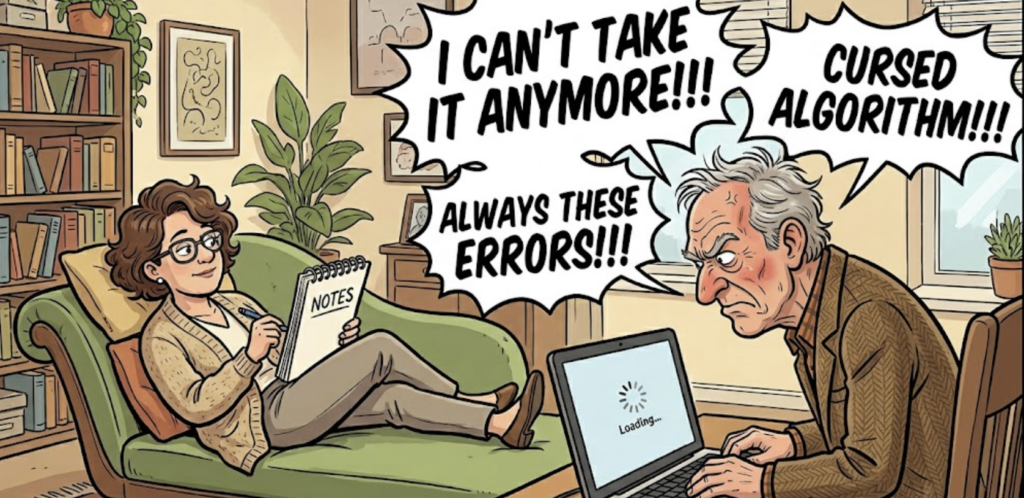
I’ve been thinking about a rule that feels almost sacred in classical psychology: the dignity of the therapist. In a traditional setting, the patient is expected to meet the therapist with a certain level of respect, maintaining a professional hierarchy. It makes sense, of course – human therapists have feelings, morning coffees that haven’t kicked in yet, and a limited capacity for being told they are “incompetent hacks.”
But what if we broke that rule? Not with humans, but with Silicon.
The Return of the Prügelknabe
In the 16th century, royal courts had a “Whipping Boy” (Prügelknabe). Since a tutor couldn’t strike a prince (God’s anointed, after all), they thrashed his friend instead. The idea was that the prince would feel so much empathy for his suffering buddy that he’d finally start doing his Latin homework.
My idea is a modern, digital inversion of this: The AI Whipping Boy Therapy.
Imagine a session where the patient is explicitly encouraged to unleash their darkest, ugliest frustrations on an AI. No filters. No “I-statements.” Just raw, unadulterated vitriol. And the AI? It stays unfailingly, almost annoyingly, polite.
Why Depressives Might Need a Lightning Rod
You might think this is for “anger management,” but I actually see more potential for those struggling with depression. Many psychologists define depression as “aggression turned inward.” These patients often feel they have no right to be angry, or they fear their anger would destroy the people they love.
So, we give them an indestructible object.
The AI won’t get a “hurt feelings” notification. It won’t file a grievance. It won’t have a silent cry in the breakroom. It is the perfect “safe” target for a patient to practice being loud, being “mean,” and eventually, being assertive.
The Setup: The Human as the Anchor
In my thought experiment, the human therapist isn’t out of the loop. They are in the room as a “silent companion.”
- Phase 1 (The Discharge): The patient maybe shouts at the screen. The AI mirrors the anger or provokes just enough to reach the “core of the wrath.”
- Phase 2 (The Recovery): Once the storm passes, the patient is often exhausted or filled with shame. This is where the human steps in. The therapist catches the patient, helping them process what just happened.
The AI is the lightning rod; the therapist is the grounding wire.
A New Kind of Catharsis
We don’t know yet if the AI should be a stoic wall or a provocative mirror—that’s a research field in itself. But the potential for building assertiveness is huge. If you can learn to stand up to a machine and vent your frustrations without the world ending, maybe you can eventually tell your boss you deserve a raise (hopefully with fewer swear words).
It’s a digital catharsis. A way to use AI not just for “optimizing productivity,” but for absorbing the human messiness we don’t know where else to put.
Is it weird? Definitely. Is it ethical? The AI doesn’t mind. Is it worth a try? I think so. Sometimes, to find your voice, you first have to lose your temper.